


My first funnel sold a coaching class through a webinar.
The course cost several hundred dollars. I ran the webinar live about five times before turning it evergreen.
I had never built a funnel, so I hired someone to help. It cost roughly $5,000—and the person I hired still needed the offer, copy, emails, examples, decisions, and approximately 4,000 answers from me.
After all that work, I sold three courses.
The sales did not cover the investment. I was exhausted, called the project a failure, and abandoned it.
If I had built that first version in an afternoon or over a weekend, those same three sales would have felt like useful starting data. I would have had three customers to learn from and enough energy left to improve the funnel.
The cost of learning was too high.
That experience changed how I think about sales funnel optimization. Your first funnel needs to be affordable and editable enough that you can learn from it after people use it.
A funnel built in Pagewheel can be edited after launch: you can change text, add or remove sections, move them, adjust layouts, and republish. When your checkout uses Digistore24, use the reporting and comparison tools available in your account to evaluate supported sales-process variants.
That gives you a much better response than burning the whole thing down and starting over.
Sales Funnel Optimization Is Not Changing Everything
When sales disappoint us, our first reaction is often panic.
The headline is wrong. The price is wrong. The page is ugly. The emails need rewriting. The product needs another bonus. The button should be orange.
So we change all of it.
Then the numbers move—or do not move—and we have no idea why.
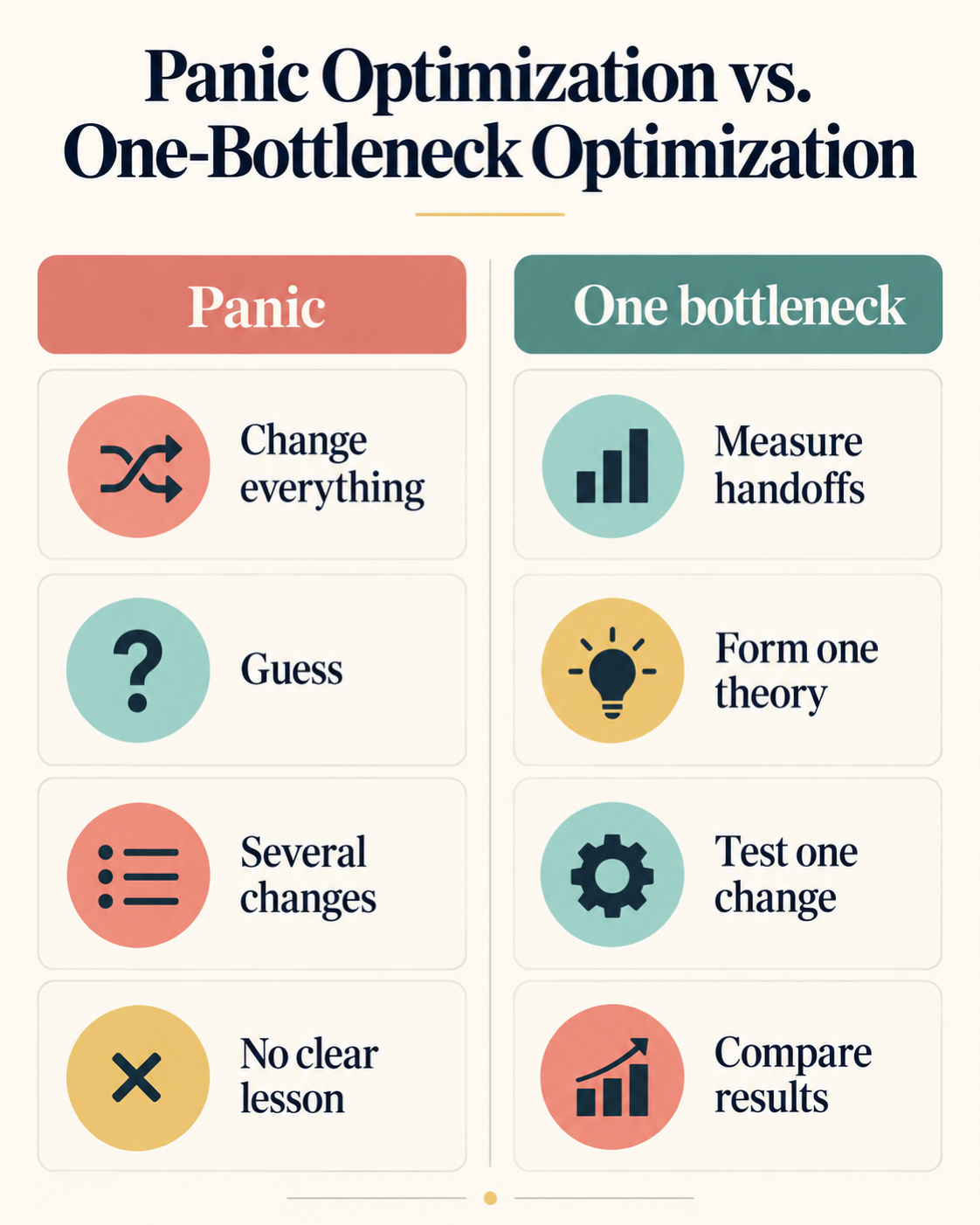
| Panic | Optimization |
| Change the headline, price, design, and emails together | Measure each handoff first |
| Assume the whole funnel is broken | Identify the weakest or least reliable step |
| Make decisions from frustration | Form one specific theory |
| Publish several changes | Test one meaningful change |
| Hope sales improve | Compare the result with the previous version |
Real sales funnel optimization is much less dramatic.
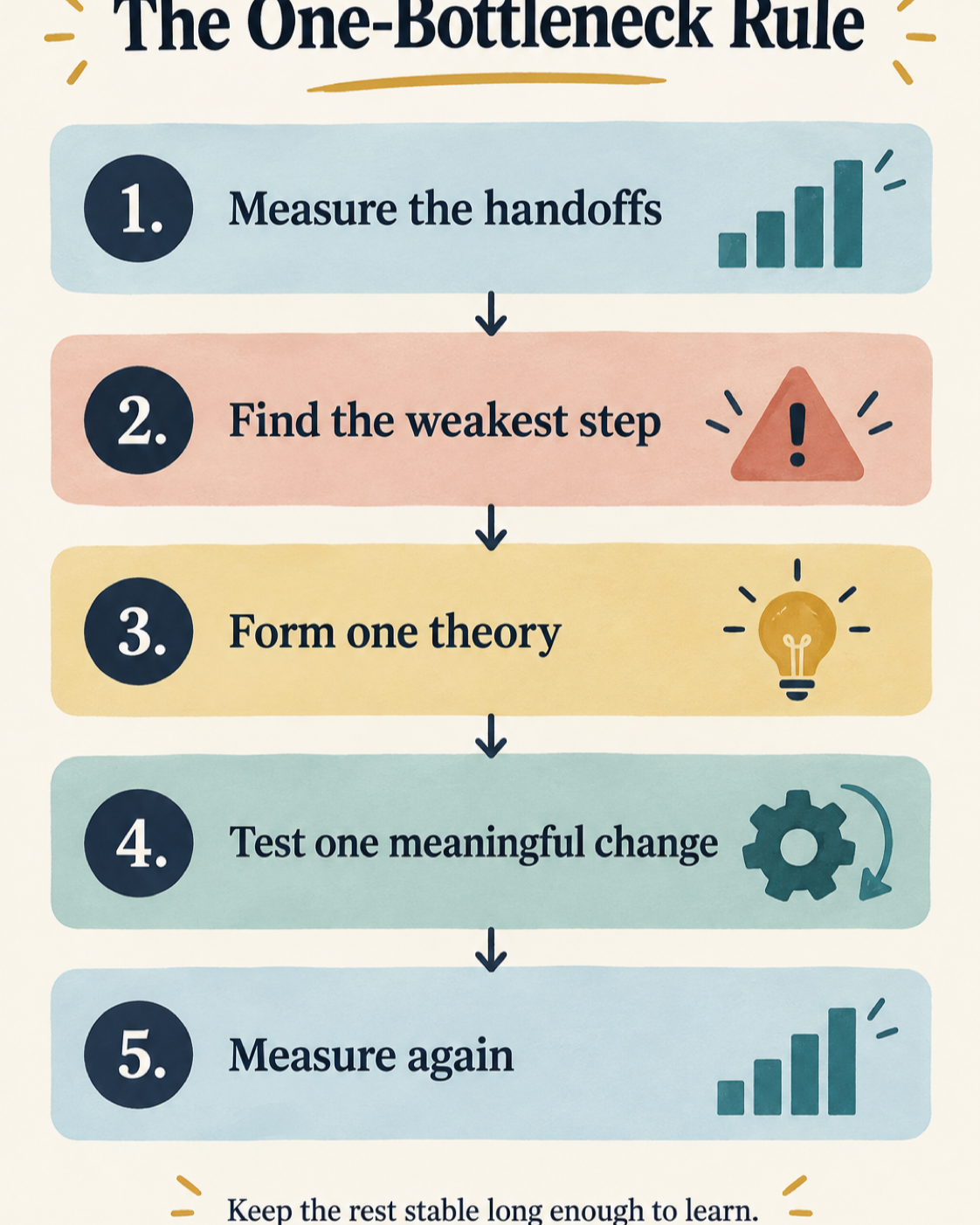
Measure. Find the bottleneck. Change one thing. Measure again.
That is the whole philosophy.
Start With a Four-Part Funnel Scorecard
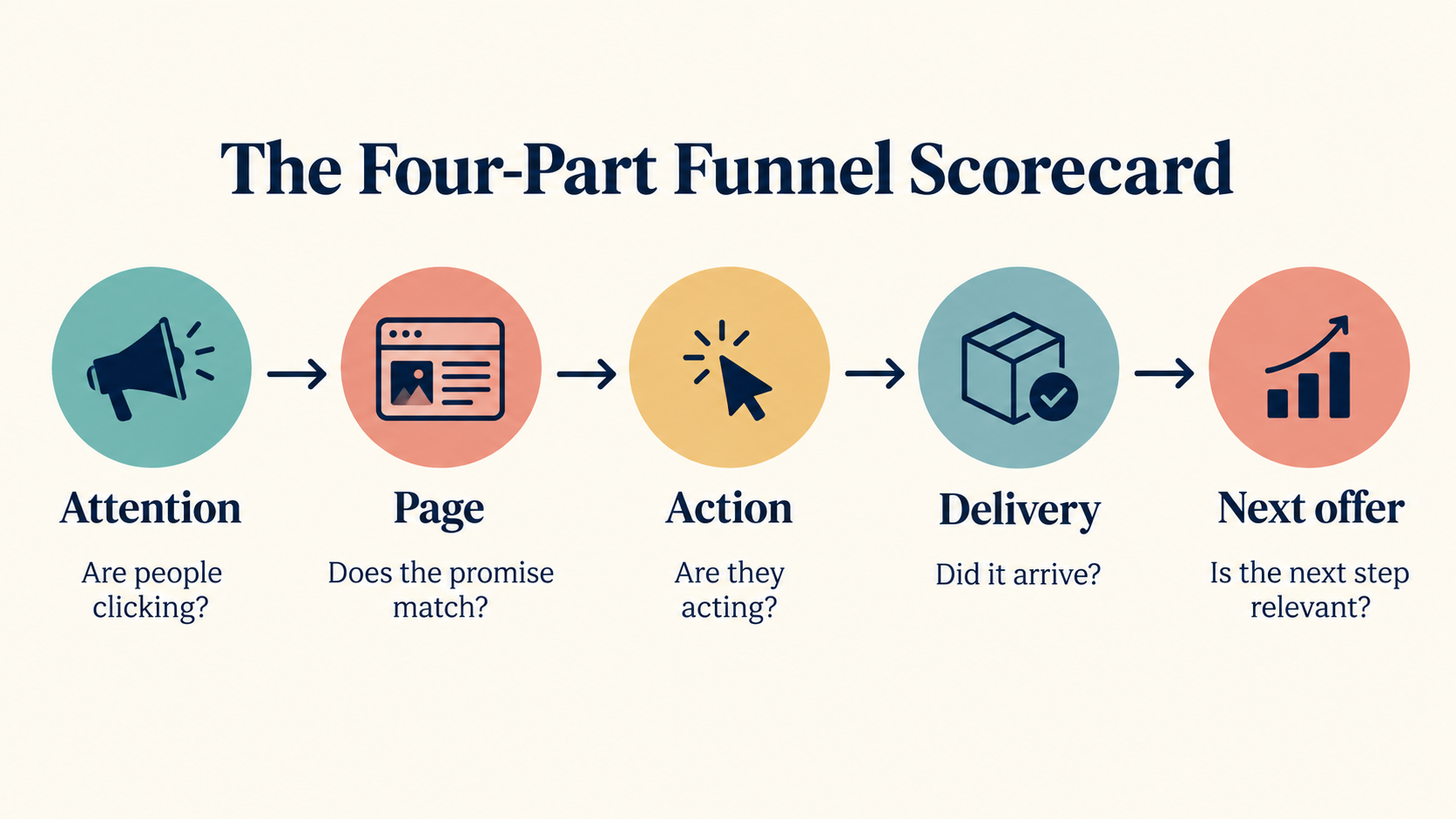
A creator funnel is a series of handoffs.
Someone sees the promotion. Some people click. Some take the main action. Buyers receive the product. Some customers or leads continue to the next useful offer.
When you look only at the final number of sales, you cannot see which handoff needs attention.
| Handoff | Simple metric | Question it answers | Where to find the data |
| Attention → Page | Page visits divided by impressions, opens, or sends | Is the promotion earning the click? | Email, social, ad, or traffic-source analytics |
| Page → Action | Opt-ins or purchases divided by page visitors | Does the page fulfill the promise that earned the click? | Tracking pixel or page analytics; Digistore24 when properly tracked |
| Purchase/Opt-in → Delivery | Successful access compared with completed actions | Did people receive what they requested or bought? | Delivery tests, customer messages, email records, and support data |
| Lead/Buyer → Next Offer | Next-offer purchases divided by eligible leads or buyers | Is the next step relevant and timed well? | Digistore24 funnel and upsell statistics; email-platform data |
Do not begin by comparing yourself with a random benchmark from a completely different business.
A $9 printable sent to an email list will not behave like a $900 course promoted through cold ads. Traffic source, audience trust, price, promise, device, season, and offer complexity all change the numbers.
Start with your own baseline.
Write down the four numbers you have. If you do not have one of them, write down what is missing and fix the measurement before you redesign the page.
Metric 1: Attention to Page
This tells you whether the promotion is earning a click.
Look at the content immediately before the funnel: the email, social post, ad, video, podcast mention, or affiliate promotion.
A low click rate can mean the hook is too broad, the intended person is unclear, the promised result does not feel urgent, or the message is reaching the wrong audience. Do not fix this by rewriting the checkout page. The visitor has not reached it yet.
Metric 2: Page to Action
This is the landing-page or sales-page conversion rate.
For a free resource, the action is usually an opt-in. For a paid offer, it is a purchase or a click into checkout.
If people click but do not act, inspect the handoff. The headline should match the promotion, and the product and next step should be obvious.
Pagewheel lets you edit an existing offer page after publication. You can revise text, add or hide sections, move sections, change layouts, and update buttons or links without rebuilding the entire site.
If the page structure itself does not fit the offer, use the landing page templates guide to choose a better starting point before you test the smaller details.
That is exactly what you want during optimization: a page that can change without becoming another three-month project.
Metric 3: Action to Delivery
A person opts in or pays. Then what?
If the funnel begins with a lead magnet, this handoff includes the thank-you page, delivery email, and download or access link.
Test the full experience yourself. Submit the form. Complete a purchase. Open the thank-you page. Open the delivery email. Click the product link. Try it on your phone.
A delivery problem is not a copy problem.
Changing the headline will not fix a broken link.
Pagewheel connects the offer page, delivery page, and delivery email around the product. It also allows the product and website to be edited after launch.
The system still needs a human test. Always make sure the customer receives what you promised.
Metric 4: Lead or Buyer to Next Offer
This handoff measures what happens after the first yes.
The next offer might be an upsell, a paid product after a free opt-in, a related course, or an email follow-up.
If it struggles, check relevance before adding urgency. A meal plan might lead to a grocery-planning system. A random product does not become relevant because it appears on an upsell page.
Use the One-Bottleneck Rule
Once you have the scorecard, choose one focus.
Not necessarily the smallest percentage. Choose the weakest handoff in context.
Delivery should be reliable before you send more traffic. A tracking gap needs to be fixed before you interpret the numbers. A page with twelve visits does not provide the same confidence as one with twelve hundred.
Digistore24’s Conversion Cockpit includes a trust indicator based on visitor volume. The indicator rises as a variant receives more visitors, giving you a practical reminder that tiny samples are less dependable.
| What the scorecard shows | Start here | One useful first test |
| People see the promotion but do not click | Hook, audience, or traffic source | Rewrite the hook for one specific person and result |
| People click but do not opt in or buy | Promise and page | Match the page headline to the promotion |
| People act but cannot access the product | Delivery path | Test and repair the thank-you page, email, and product link |
| Leads or buyers ignore the next offer | Relevance and timing | Offer the most logical next result instead of a general product |
| Visitor data is missing or unreliable | Tracking setup | Add the correct tracking path before changing the funnel |
The rule is simple:
Fix one meaningful bottleneck. Keep the rest stable long enough to learn from the result.
You can redesign a page. Just have a clear reason and a way to judge whether the change helped.
What to Test at Each Funnel Stage
A good test begins with one sentence:
I think [specific problem] is reducing [specific metric]. I will change [one element] and compare the result.
“Make the funnel better” is not a test.
| Bottleneck | Possible test | What stays the same | What you measure |
| Attention → Page | Try a more specific hook | Offer, page, price, and audience | Click-through rate |
| Attention → Page | Try a different format, such as short video instead of a static image | Core message and destination page | Qualified page visits |
| Page → Action | Match the headline to the promotion | Price, product, checkout, and follow-up | Opt-in or purchase rate |
| Page → Action | Remove an unnecessary distraction or form field | Main promise and traffic source | Completed actions |
| Page → Action | Add a relevant preview, example, or testimonial | Price and checkout | Completed actions and earnings per visitor |
| Action → Delivery | Repair or clarify the thank-you page and delivery email | Offer and promotion | Successful access and support messages |
| Next Offer | Change the next offer to a closer problem match | Front-end offer and traffic | Next-offer conversion and earnings per visitor |
| Next Offer | Test timing or explanation | Product and price | Next-offer response |
If you are working in Pagewheel, edit the section connected to the theory. Change the headline if the promise is unclear. Add proof if the visitor cannot trust the result. Hide a section if it distracts from the action. Move the preview if the buyer cannot understand what she receives.
Do not change the font because you are nervous.
Use Digistore24’s Conversion Cockpit for Sales Tests
Pagewheel makes the funnel easier to build and edit. Digistore24’s Conversion Cockpit handles specific sales-process measurement and split testing when your offer uses Digistore24 checkout.
The Conversion Cockpit can compare:
- Products at positions in an upsell flow
- Sales pages for the initial product
- Upsell pages
- Order forms
You can control how traffic is divided among variants. The reporting includes visitors, purchases, conversion rate, earnings, and earnings per visitor.
For initial-product sales-page tracking and split testing, the funnel needs to enter through a Digistore24 promolink or use a promo pixel on the sales page. Without that setup, Digistore24 may record buyers without counting all sales-page visitors.
That detail matters. Optimization built on incomplete visitor data can point you toward the wrong problem.
Why Earnings per Visitor Matters
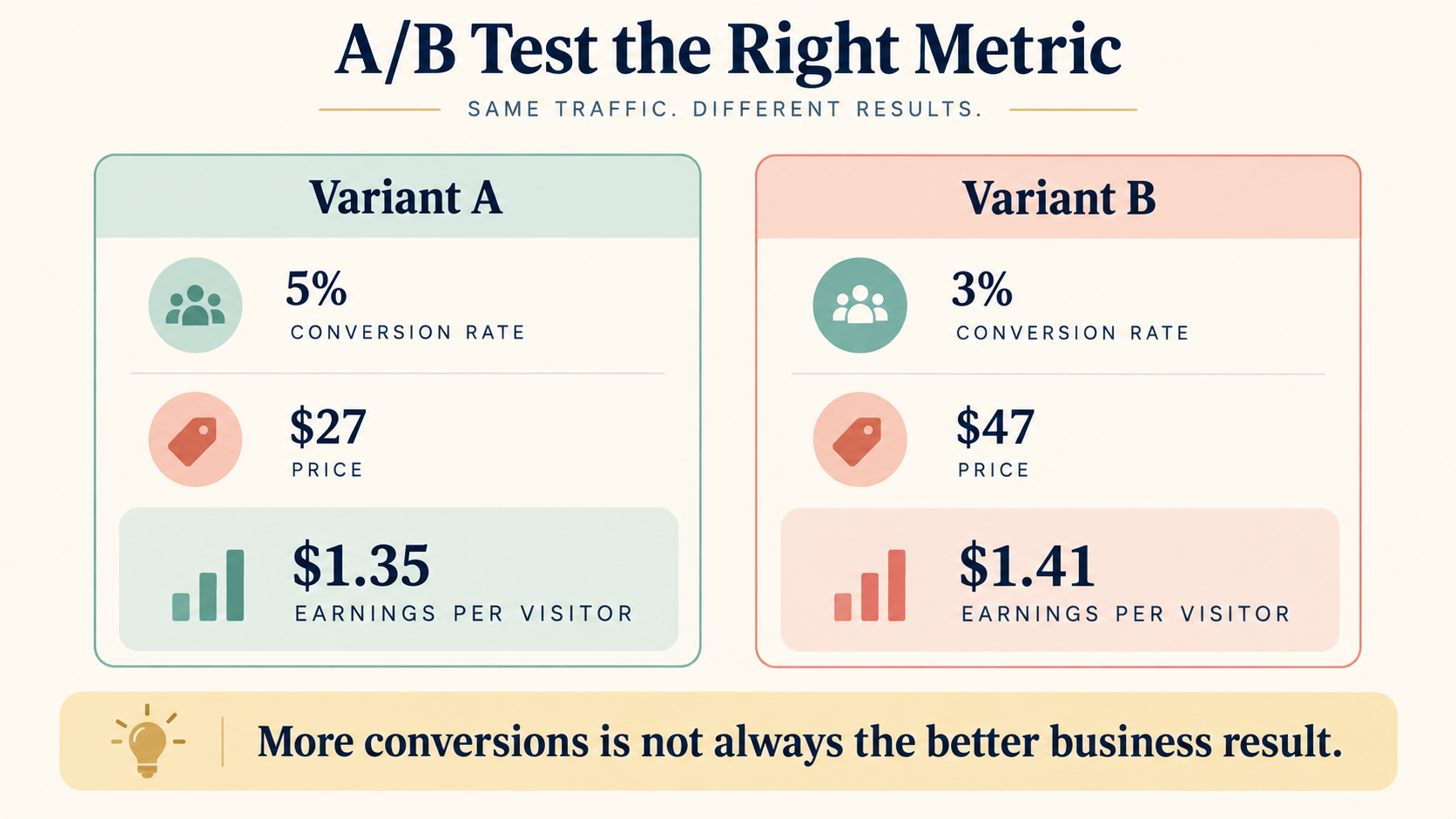
The variant with the highest conversion rate is not always the one that produces the most revenue.
Here is a simple illustration:
| Variant | Conversion rate | Price | Earnings per visitor before fees, refunds, or other costs |
| A | 5% | $27 | $1.35 |
| B | 3% | $47 | $1.41 |
Variant A converts more visitors.
Variant B produces slightly more gross revenue per visitor in this simplified example.
Refunds, customer value, support costs, and sample size still matter. The example simply shows why “more conversions” and “better business result” are not always the same sentence.
Audit One Pagewheel Funnel
Imagine a Pagewheel funnel with this path:
Social post → sales page → Digistore24 checkout → Pagewheel delivery page and email → related next offer
Traffic is arriving, and a few sales are happening. Before replacing the page, lowering the price, rewriting the emails, and adding three bonuses, run the audit.
Step 1: Confirm the Path Works
Follow the funnel from beginning to end.
Click the promotional link. View the page on a phone. Enter checkout. Complete a real or approved test purchase. Confirm delivery. Check the next offer.
Repair broken steps before testing persuasion.
Step 2: Record the Four Handoffs
Pull attention and click data from the traffic source. Use the tracking available for the page. Review purchases and funnel activity in Digistore24. Check delivery records and customer messages. Review the next-offer data.
If a number is missing, measurement is the first task.
Step 3: Choose the Bottleneck
Suppose the promotion earns clicks and delivery works, but very few page visitors enter checkout.
The current theory is not “the funnel is bad.”
It is “the sales page may not make the promise, product, or next step clear enough.”
Step 4: Make One Change
Edit the Pagewheel offer page. Match the headline to the language used in the promotion. Leave the price, checkout, delivery, and next offer alone.
If you have enough traffic for a useful comparison and the setup is correct, create a page variant and use Conversion Cockpit to divide traffic between the sales-page URLs.
Step 5: Keep or Reject the Change
Let the test gather enough traffic to become more trustworthy. Compare conversion rate, earnings, and earnings per visitor.
If the new version performs better, keep it. If it does not, return to the original and test the next reasonable theory.
That is sales funnel optimization.
It is useful.
Do a Weekly Funnel Check—Not Necessarily a Weekly Change
A short weekly check-in keeps the funnel from disappearing into the part of the business I pretend does not exist. Checking every week does not mean changing it every week.
If traffic is low, a seven-day test may tell you almost nothing. Keep collecting data, talk to customers, watch support questions, and use Digistore24’s trust indicator as one signal about how much confidence to place in a variant.
| Weekly check | Action |
| Record the four handoffs | Use the same date range and definitions each time |
| Confirm tracking and delivery | Fix broken measurement or access first |
| Review the active test | Ask whether the result has enough data to be useful |
| Keep, stop, or continue | Do not declare a winner because of two purchases |
| Choose the next action | Continue collecting data or test one new theory |
Write the test in one sentence:
This week, I am testing [specific change] on [specific page or handoff] because I believe it will improve [specific metric].
That sentence keeps an anxious Monday from becoming an accidental funnel demolition.
Frequently Asked Questions About Sales Funnel Optimization
What is sales funnel optimization?
Sales funnel optimization is the process of measuring each handoff in a funnel, finding the weak or unreliable step, making a focused change, and comparing the result.
How do I know where my funnel is losing people?
Track the movement from attention to page, page to opt-in or purchase, purchase or opt-in to delivery, and lead or buyer to the next offer. The biggest unexpected drop—or a broken delivery or tracking step—is the place to investigate first.
What is a good funnel conversion rate?
There is no universal number. A free opt-in, low-ticket printable, coaching course, warm email list, and cold ad campaign behave differently. Use outside benchmarks as context, not a verdict. Your best comparison is usually the same funnel, traffic source, and offer over time.
What should I test first?
Fix broken tracking or delivery first. Then test the bottleneck closest to the evidence you have. If people do not click, test the hook. If they click but do not act, test the page. If buyers do not continue, test relevance and timing.
How long should I run a funnel test?
Long enough to gather useful, comparable traffic and customer behavior. Calendar time alone does not make a result trustworthy. A small funnel may need to run the same test much longer.
What tools do I need?
You need editable pages, reliable traffic and conversion tracking, checkout data, and a way to compare changes. Pagewheel provides editable offer and delivery pages. Traffic-source analytics or a tracking pixel can measure activity before checkout. Digistore24’s Conversion Cockpit can measure and compare supported sales-process variants when the tracking path is configured correctly.
If you do not have a funnel yet, start with the how to sell digital products guide. Build the simplest complete path first. Then optimize it after real people use it.
Make the Funnel Cheap Enough to Learn From
I wish I had treated my first three course sales as data.
Instead, the $5,000 funnel and months of work made those sales feel like a final grade. I had invested so much in Version One that I had nothing left for Version Two.
That is the Pagewheel benefit I care about here.
You can build the first funnel without turning it into a major construction project. After it is live, you can edit the page, change sections, update the product, and republish.
Then Digistore24 can help you measure the sales process and run supported split tests through Conversion Cockpit.
Open the funnel. Record the four handoffs. Find the weakest or least reliable one.
Choose one change.
Measure again.
Rinse and repeat.