
Kids Activities Blog has more than 1,800 opt-ins.
That is 1800 digital products that I have launched in the last few years. Most of them are coloring page packs, but there are many other digital product ideas like play guides, checklists, calendars, and anything I could think of that might be useful for a parent to download.
That sounds like I must have started with 1,800 brilliant digital product ideas!
I did not.
I started with one set of coloring pages.
At first, launching even one digital product felt overwhelming. Then I did it once. I did it again. I created a process. I started looking at what parents were already searching for and making the simplest useful resource that answered that search.
After that, the ideas became much easier to see.
The first product did not need to be my greatest idea. It needed to teach me how to create Product Number Two.
That is the part most giant lists of digital product ideas miss.
You do not need 50 more possibilities. You need a way to choose one idea that makes sense for one person right now.
The Idea Paralysis Trap: More ideas can create more paralysis. You do not need Idea Number 51. You need a way to choose from the ideas already sitting in your head, notes app, Google Drive, old presentations, and unfinished folders.
Here is the filter I wish every beginner would use.
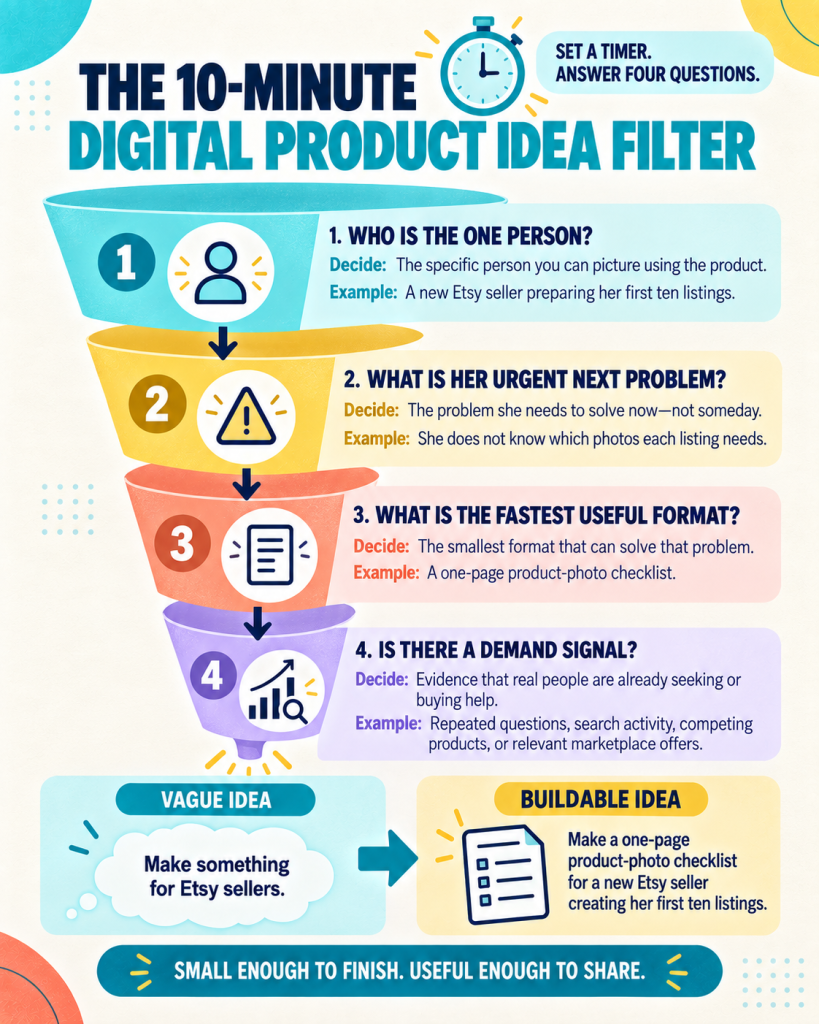
The Four-Question Filter for Digital Product Ideas
Set a timer for ten minutes. Answer these four questions without trying to sound impressive.
The goal is not to identify the most profitable digital product idea in the history of the internet.
The goal is to find the smallest useful idea you can finish, share, and learn from.
| Question | What you are deciding | Example answer |
| Who is the one person? | The specific person you can picture using the product | A new Etsy seller preparing her first ten listings |
| What is her urgent next problem? | The problem she needs to solve now—not someday | She does not know which photos each listing needs |
| What is the fastest useful format? | The smallest format that can solve that problem | A one-page product-photo checklist |
| Is there a demand signal? | Evidence that real people are already seeking or buying help | Repeated questions, search activity, competing products, or relevant marketplace offers |
At the end, the idea is no longer “make something for Etsy sellers.”
It is “make a one-page product-photo checklist for a new Etsy seller creating her first ten listings.”
That is a product you can actually build.
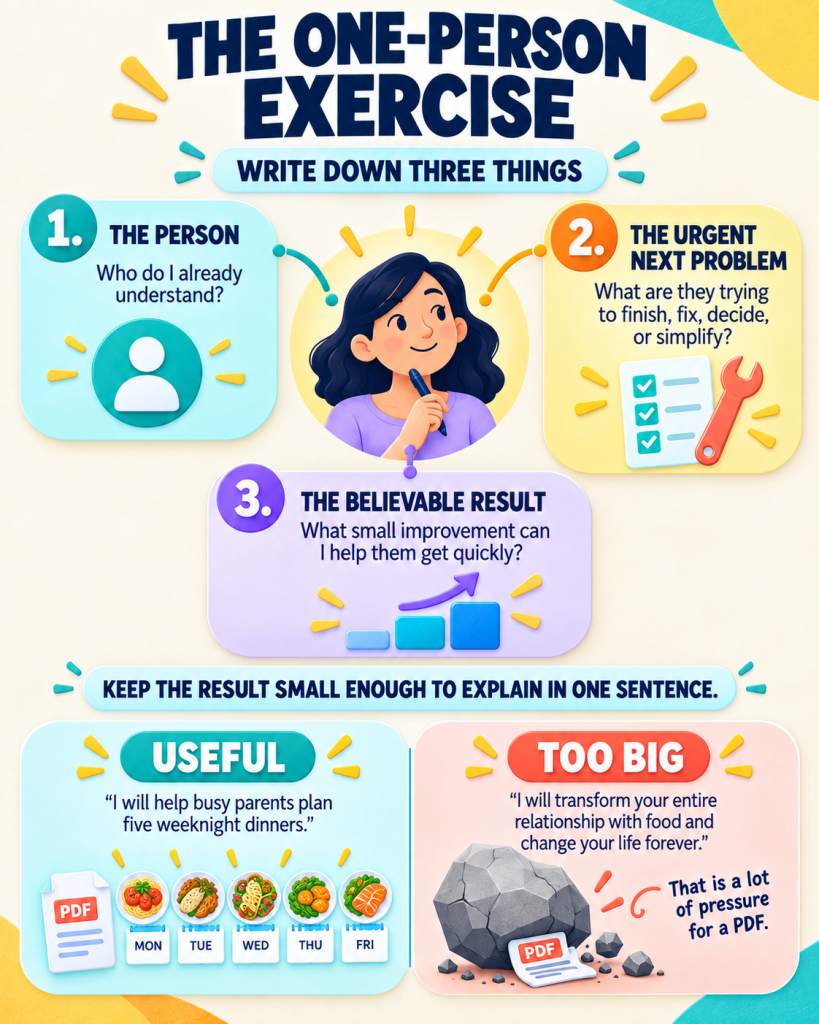
Question 1: Who Is the One Person?
“Everyone” is not a customer description.
Neither is “women,” “small business owners,” or “beginners.”
Picture one real person. What is she doing? What has she already tried? What does she need to accomplish next?
My coloring pages were not for every person who likes art. They were for a parent who had searched for a specific kind of coloring page and wanted something easy to print for a child.
That specificity helped me decide what to make and what did not need to be included.
Try one of these sentence starters:
- A new coach preparing for her first paid client
- A parent planning a rainy afternoon for a five-year-old
- A freelance writer onboarding a first recurring customer
- A content creator trying to plan next month’s posts
- An author helping a book club discuss her novel
You can widen the audience later. Start with somebody you can see.
Question 2: What Is the Urgent Next Problem?
Do not solve the person’s entire life.
Solve the next thing standing in the way.
A new coach may eventually need a complete certification program. This week, she may need a client intake form and a first-session worksheet.
A parent may want to raise creative, curious children. This afternoon, she may need printable dinosaur coloring pages.
The most useful digital products often feel small because the problem is specific.
Small is not a weakness. Small makes the promise easier to understand.
Question 3: What Is the Fastest Useful Format?
Format follows the problem.
If the customer needs to remember five steps, create a checklist.
If she needs to repeat a process, create a template.
If she needs examples and explanation, create a short guide.
If she needs to watch a task being performed, create a short tutorial or mini-course.
If she needs to organize information over time, create a planner, tracker, calendar, or workbook.
Choose the smallest format that can create the promised result. A twelve-module course is not automatically more valuable than a one-page checklist.
It is definitely harder to finish.
Question 4: Is There a Demand Signal?
A demand signal is evidence that people care about the problem.
It is not a guarantee that they will buy your version.
For Kids Activities Blog, search activity helped me choose which coloring pages to create. If parents were already searching for a particular topic, that told me the need was not imaginary.
You can also look for repeated customer questions, comments in relevant communities, competing products, popular videos, bestselling books, or related offers in an affiliate marketplace.
Digistore24 currently describes its marketplace as containing more than 10,000 offers across 44 niches. That makes it useful for exploring categories, language, prices, and problems that sellers and affiliates are already working with.
It does not mean every similar product will sell.
Use the marketplace as one signal. Then look for the same problem in at least one other place.
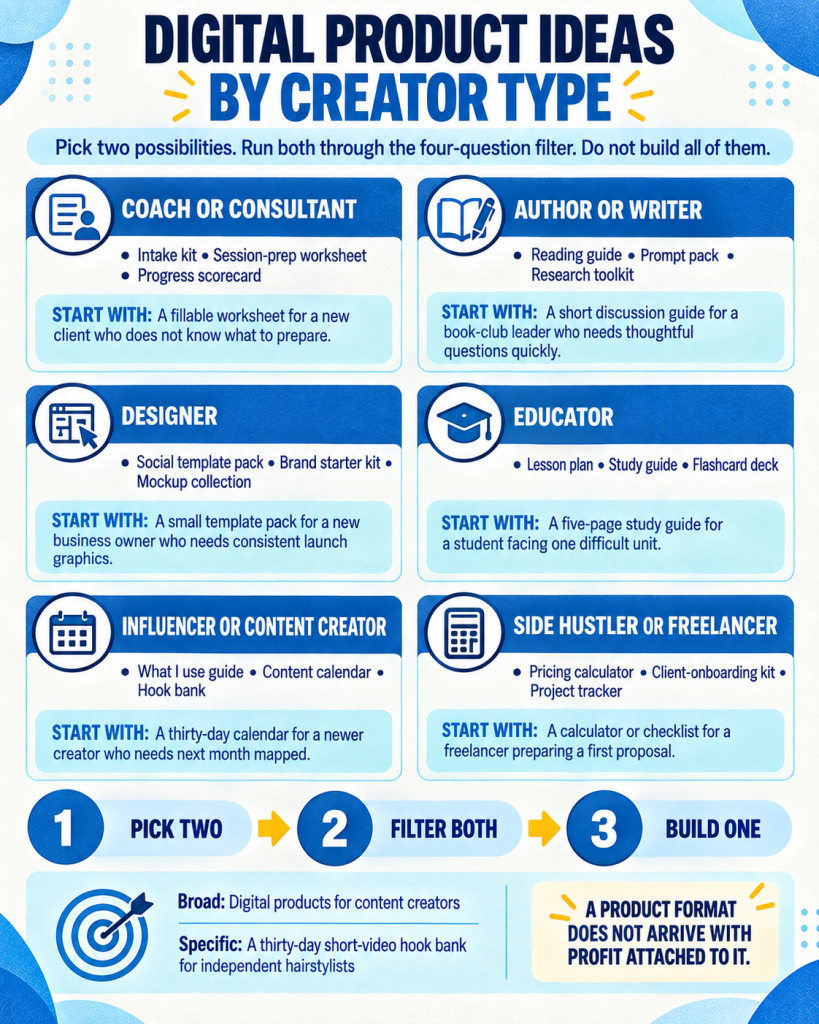
Digital Product Ideas by Creator Type
This is the only idea list in this article.
Use it when your mind is completely blank. Pick two possibilities that fit what you already know, then run both through the four-question filter.
Do not build all of them.
| Creator type | Three possible products | One person | Urgent problem | Fastest starting format |
| Coach or consultant | Intake kit, session-prep worksheet, progress scorecard | A new client arriving for a first session | She does not know what to prepare | Fillable worksheet |
| Author or writer | Reading guide, prompt pack, research toolkit | A book-club leader planning next week’s discussion | She needs thoughtful questions quickly | Short discussion guide |
| Designer | Social template pack, brand starter kit, mockup collection | A new business owner announcing a launch | She needs consistent graphics without hiring a designer | Small template pack |
| Educator | Lesson plan, study guide, flashcard deck | A student preparing for one difficult unit | He needs a manageable review plan | Five-page study guide |
| Influencer or content creator | “What I use” guide, content calendar, hook bank | A newer creator posting inconsistently | She needs next month’s content mapped | Thirty-day calendar |
| Side hustler or freelancer | Pricing calculator, client-onboarding kit, project tracker | A freelancer preparing a first proposal | She does not know what to charge or collect | Calculator or checklist |
The category is only a starting point.
“Digital products for coaches” is still too broad. “A first-session preparation kit for a newly certified nutrition coach” is much closer to a product.
“Digital products for content creators” is broad. “A thirty-day short-video hook bank for independent hairstylists” gives you something to create.
This is also why I would not choose based only on what someone calls the most profitable digital product ideas.
Profit depends on demand, positioning, price, traffic, conversion, delivery, refunds, support, and expenses. Results vary.
A product format does not arrive with profit attached to it.
The One-Hour Digital Product Idea Check
You have an idea. Before you spend a week building it, spend an hour looking for evidence.
This is not scientific market research. It is a quick check designed to catch obvious problems and help you ask better questions.
| Time | Check | What to look for | What it can tell you |
| 10 minutes | Search activity | The exact language people use and related questions | Whether people are actively looking for help |
| 10 minutes | Digistore24 marketplace | Relevant categories, offers, prices, positioning, and affiliate activity | Whether sellers are investing in the broader problem area |
| 15 minutes | Communities and comments | Repeated questions, frustration, workarounds, and missing resources | How real people describe the problem |
| 15 minutes | Competitors | Similar products, reviews, pricing, strengths, and gaps | What buyers can already choose and what may be missing |
| 10 minutes | Interest check | Direct replies, waitlist signups, or conversations with likely users | Whether your specific promise earns attention |
Start With Search Activity
Search the exact problem, not just the product name.
For my coloring pages, I did not begin with “What PDF should I create?” I looked at what parents were searching for and created resources around that demand.
Read the related searches and questions. Notice the nouns people use. Notice whether they want instructions, examples, a template, a printable, or a recommendation.
This can also uncover a better format. People may not want a twenty-page guide. They may want one printable page they can use in ten minutes.
Browse the Digistore24 Marketplace
Search the broader category and look at how existing offers describe the customer, problem, and result.
Competition is not automatically bad. It can show that sellers, affiliates, and buyers are active in the category.
No competition is not automatically a secret opportunity. It may mean the product uses different language, lives in another category, or has very little demand.
Look for patterns. Do not copy another product.
Read Real Questions
Search communities where the one person already gathers. Read public discussions, comments, reviews, and questions.
You are looking for repeated language, not one dramatic complaint.
Save the phrases people use. Those phrases may help you clarify the product, title, sales page, and examples.
If you participate in a community, follow its rules. Do not drop a sales pitch into a group that prohibits promotion.
Test the Specific Promise
Talk to a few people who resemble the intended customer.
Describe the product plainly:
I am creating a [format] for [person] who needs to [result]. It will help with [specific problem]. Would that be useful to you? What would it need to include?
You can invite people to a waitlist or offer early access. If you accept payment before the product is complete, clearly explain what the buyer will receive and when it will be delivered.
There is no magic number of replies that guarantees a winner.
You are listening for clarity. Does the person immediately understand the product? Does she describe the problem in the same way? Does she ask for something completely different?
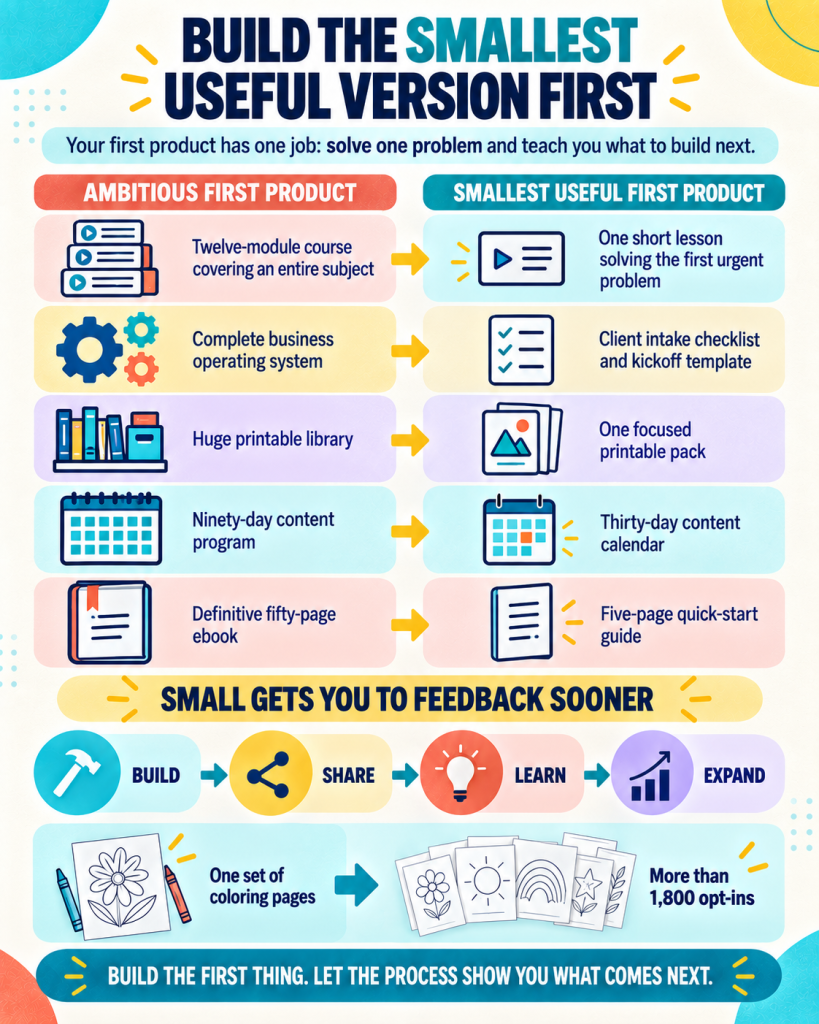
Build the Smallest Useful Version First
The first product is not supposed to contain everything you know.
Its job is to solve one problem and teach you what to build next.
| Ambitious first product | Smallest useful first product |
| Twelve-module course covering an entire subject | One short lesson solving the first urgent problem |
| Complete business operating system | Client intake checklist and kickoff template |
| Huge printable library | One focused printable pack |
| Ninety-day content program | Thirty-day content calendar |
| Definitive fifty-page ebook | Five-page quick-start guide |
A large product creates more decisions. More lessons. More design. More technology. More time before anyone can use it.
A small product gets you to feedback sooner.
This does not mean everything must remain tiny forever. My one set of coloring pages eventually became part of a library of more than 1,800 opt-ins.
But I did not build the library first.
I built the first thing. Then the process showed me what could come next.
“In order to make money, you have to launch. The ideas in your head are not making you money. They are just ideas.” — Holly Homer
Turn the Idea Into a Product With Pagewheel
Once you choose the idea, you have three easy paths for moving it into Pagewheel and turning it into a real product.
You can upload a PDF you already have. This is the most overlooked option. Look through old workshops, checklists, presentations, guides, client materials, and resources you created for yourself.
You can use an outside AI tool to help draft a PDF, review and edit it carefully, then upload the finished file.
Or you can build the product page by page inside Pagewheel. The Page-by-Page Product Builder supports branding, title help, covers, mockups, individual page types, page batches, rearranging pages, and uploaded PDF pages.
The methods can be combined. You might upload an existing guide, then add a workbook page and a new cover inside Pagewheel.
After the product is created, Pagewheel can draft the offer page, thank-you or delivery page, and delivery email around it. If the offer needs a more specialized page structure, the landing page templates guide can help you choose a starting point that fits the product.
That is why choosing a small first product does not mean choosing something sloppy.
You can start with a simple idea and still give it a professional path from “I want this” to “Here is your product.”
If you want the complete next-step process, use the how to sell digital products guide. It walks through creating or uploading the product, building the sales page, connecting free or paid delivery, and publishing the first promotion.
Frequently Asked Questions About Digital Product Ideas
What are the easiest digital product ideas for beginners?
Start with a format that uses information you already have and solves one narrow problem: a checklist, template, printable, resource list, short guide, calculator, tracker, or prompt pack.
Easy refers to the size and format. The product still needs to be useful and accurate.
What digital products are most profitable?
No format is automatically the most profitable. Profit depends on demand, price, traffic, conversion, support, refunds, platform costs, and other expenses.
Choose the product with the clearest person, most urgent problem, and simplest useful result. Then test it.
Can digital products create passive income?
I call it automated delivery, not passive income.
A customer can buy or request a digital product and receive it automatically. You still need to create, edit, promote, support, update, and improve it.
Can I sell a digital product without an audience?
You do not need a giant audience to test an idea. You do need a way to reach likely customers.
Start with direct conversations, a relevant community that permits promotion, search-focused content, an email list, social content, advertising, partnerships, or an affiliate marketplace. Each path requires work, and results vary.
How do I know whether my digital product idea will sell?
You cannot know with certainty before launching.
Look for multiple demand signals. Talk to likely customers. Study competing products. Test the promise. Build the smallest useful version. Then let real behavior teach you what to change.
Choose One Before You Close This Tab
Return to the four questions.
- Who is the one person?
- What is the urgent next problem?
- What is the fastest useful format?
- What demand signals can you find?
Write one sentence:
I am creating a [format] for [person] who needs to [result].
Now open Pagewheel. Upload what you already have or build the smallest useful version page by page. Review what the AI drafts. Make it sound like you. Publish it.
The first product does not need to prove that you chose the perfect idea.
It needs to exist long enough to teach you what Product Number Two should be.