


I have paid more than $250 a month for funnel software while the funnels inside it made $50 or $75.
That math is terrible.
I kept paying anyway.
I had live funnels in ClickFunnels and GoHighLevel. Taking them down meant broken links, rebuilding pages, and figuring out where everything needed to move.
I also kept Kajabi for about a year longer than I wanted because one of my courses lived there. Moving the course felt like a bigger project than paying another bill.
That is the part most sales funnel builder comparisons miss.
You are not only choosing software. You may be choosing where your pages, products, links, buyers, and customer access will live for years.
The longest feature list does not automatically make that choice better.
What a Creator Actually Needs From a Sales Funnel Builder
Most creators are not funnel builders.
They have an idea to test, a digital product to sell, or a lead magnet to give away. They need a short path that works:
Page → checkout → delivery → follow-up
Everything else should earn its place.
A CRM may be critical for an agency managing 50 client accounts. It may be one more screen for a creator selling a $27 ebook.
A complex automation system may support a mature business. It may delay Product Number One for three months.
The best sales funnel builder is not the one with the most features. It is the one that fits what you are building now.
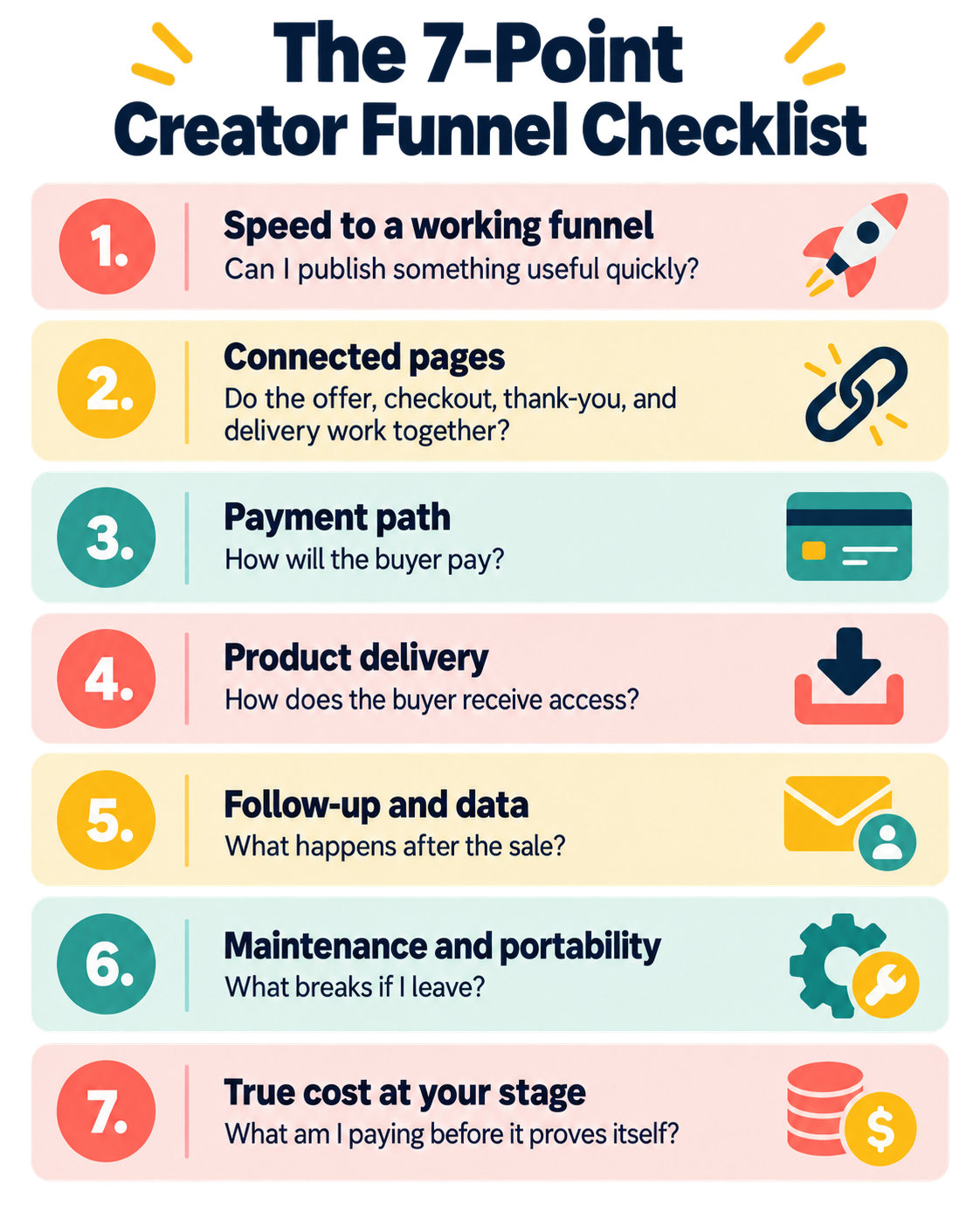
The 7-Point Creator Funnel Checklist
I would score any funnel builder against these seven questions before moving a single page into it.
| What to check | What it means in real life | The question to ask |
| 1. Speed to a working funnel | You can create the first useful version without weeks of training | How soon can I publish something a real customer can use? |
| 2. Connected pages | The offer, checkout, thank-you, and delivery path work together | Which connections do I have to build myself? |
| 3. Payment path | The buyer can pay with a checkout that fits the offer | Do I need a separate processor, order form, tax system, or integration? |
| 4. Product delivery | The buyer receives access without a manual email from you | Where does the product live, and what triggers delivery? |
| 5. Follow-up and data | You can deliver the first email, continue the conversation, and see what happens | What is native, and what requires another tool? |
| 6. Maintenance and portability | You can edit the funnel and understand what happens if you leave | What breaks, disappears, or needs rebuilding if I cancel? |
| 7. True cost at your stage | The price includes subscriptions, transaction costs, add-ons, and your time | What am I paying before this funnel proves itself? |
The last two would have saved me a lot of money.
A platform can be affordable on Day One and expensive to leave on Day 400.
The Feature Trap
ClickFunnels and GoHighLevel have a lot of features.
That is useful when you need them.
It also means you need to know what the features do, when to use them, where to find them, and how they connect. I have used both platforms. Even when you know what you are doing, locating one failed connection can be hard.
I once had a funnel stop delivering the product after people paid. I did not know where the failure happened. I ended up refunding a full month of purchases.
Horrifying.
The problem was not that the software lacked features. The problem was that I could not see and repair the path quickly.
More power creates more possibilities. It can also create more places for something to go wrong.
Choose complexity when the business needs complexity.
Do You Need a Full Funnel Platform Yet?
A creator testing one product may need less than expected.
A minimum viable sales funnel could be one sales page, one payment path, one delivery page, and one delivery email.
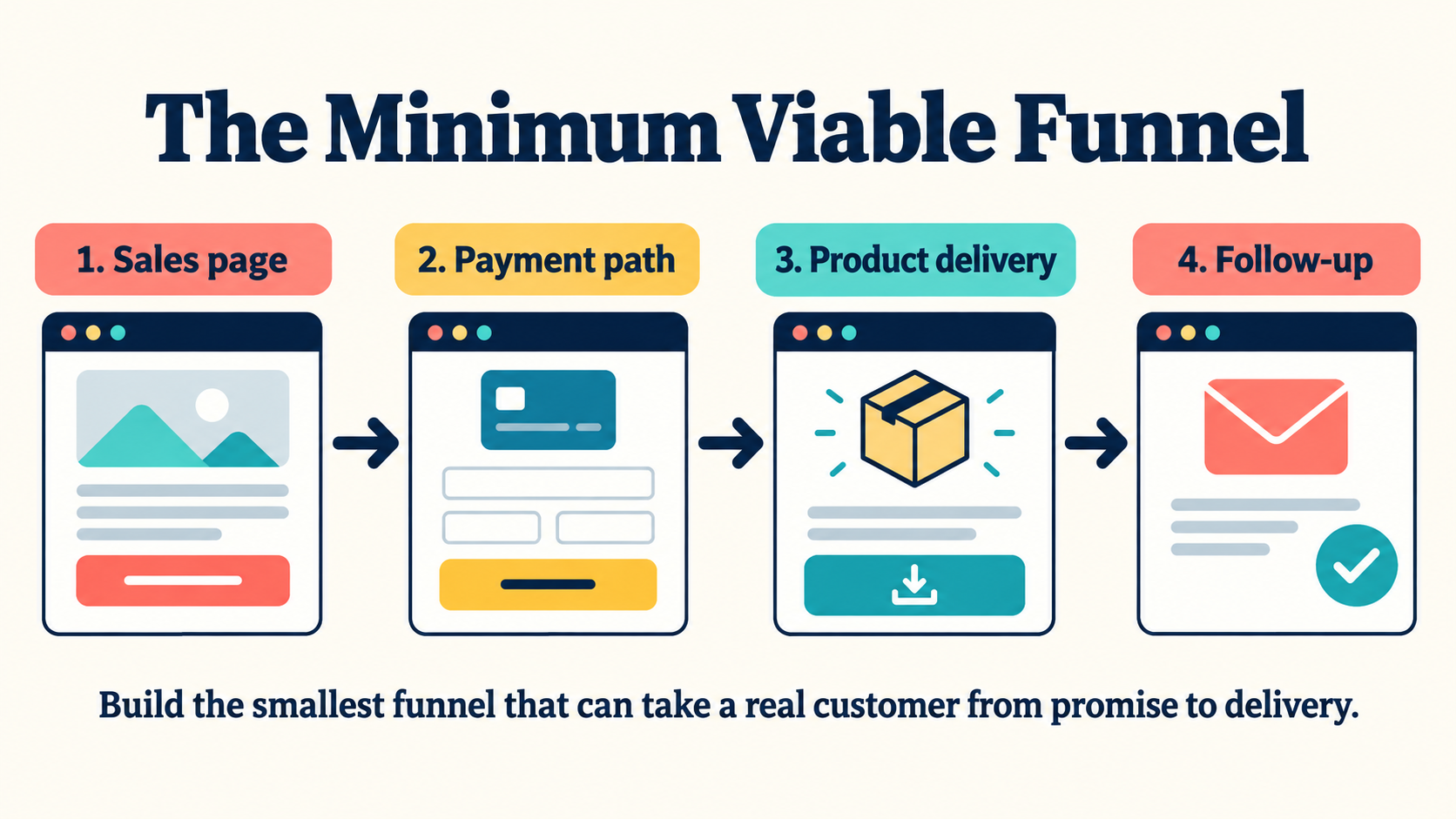
That is enough to learn:
- Whether the promise makes sense
- Whether people click
- Whether the checkout works
- Whether buyers receive the product
- Which questions arrive after purchase
The questions are the useful part.
A live, simple funnel gives you information. A giant funnel diagram sitting in a notebook gives you homework.
The Pagewheel how to sell digital products guide walks through that first product path. The Pagewheel sales funnel optimization guide shows how to improve one bottleneck after it is live.
Build the amount of funnel the offer needs.
Sales Funnel Builder Comparison for Creators
Kajabi is included because I have used it, too. It is a larger course and creator-business platform—not only a funnel builder.
The prices below are current published U.S. prices checked September 16, 2026. Annual-equivalent prices usually require paying for a year. Trials, plan limits, processing fees, and optional services vary.
| Platform | Current entry point | What it does especially well | Best fit |
| ClickFunnels | $97/month; $81/month equivalent billed annually | Funnels, checkout, courses, email, workflows, CRM tools, and A/B testing in one direct-response system | Marketers who want a larger funnel platform and expect to use its testing and sales infrastructure |
| Kartra | Essentials is $59/month with limits and a 5% platform transaction fee; Starter is $119/month | Pages, checkout, email, memberships, CRM, analytics, and help-desk-style business tools | Established creators or small businesses wanting a broad all-in-one system |
| Systeme.io | Free plan available; paid plans start at $17/month | Low-cost funnels, email, courses, automation, checkout integrations, and affiliate tools | Budget-conscious creators comfortable building inside an all-in-one system |
| GoHighLevel | $97/month; usage charges can apply | CRM, pipelines, client sub-accounts, funnels, calls, SMS, email, calendars, reviews, and agency automation | Agencies, freelancers, and businesses managing several clients or locations |
| Kajabi | $179/month; $143/month equivalent billed annually | Courses, communities, landing pages, email, checkout, and customer management | Experts building a larger course, membership, or community business |
| Pagewheel + Digistore24 | Pagewheel publishing starts at $10/month; advanced funnels are $47/month. Digistore24 has no monthly account fee and charges per transaction | AI-assisted page and product creation, connected delivery, managed hosting, Digistore24 checkout, and optional affiliate distribution after marketplace approval | Creators who want to launch and test a focused product without first building an agency CRM or large course platform |
This is not a rigged table where Pagewheel wins every row. GoHighLevel makes more sense for many agencies. Kajabi may fit a mature course business. ClickFunnels provides deeper direct-response infrastructure. Systeme.io has a useful free plan.
Pagewheel fits the creator who wants the shortest useful path from idea to live offer.

A Closer Look at Each Funnel Builder
ClickFunnels
ClickFunnels includes funnel pages, checkout, courses, email allowances, CRM-style tools, workflows, and A/B testing. Its Launch plan is $97 monthly; higher plans raise limits and access.
I have used it. It makes sense when the funnel is a major sales system. For one lightly selling product, it can become more house than the offer needs.
Kartra
Kartra combines pages, courses, memberships, email, checkout, affiliates, lead management, video, calendars, help desks, and funnel analytics.
Its $59 Essentials plan is limited to five pages and one product and carries a 5% Kartra transaction fee. Affiliate management and advanced automation require higher plans. It fits someone who intends to use the broader system.
Systeme.io
Systeme.io is the strongest budget option here. Its free plan includes up to 2,000 contacts, three funnels, one course, one affiliate program, and one custom domain. The $17 Startup plan allows unlimited funnels and raises the contact limit.
Email, courses, checkout integrations, upsells, order bumps, A/B tests, and affiliate tools are included. The remaining question is how much you want to assemble and manage yourself.
GoHighLevel
GoHighLevel is built to grow into multi-client work. It combines sub-accounts, CRM pipelines, funnels, email, SMS, calls, calendars, payments, courses, communities, reviews, and more.
Plans start at $97 monthly, with $297 and $497 agency tiers. Usage charges can apply to communication and AI features. I have used it. The connections are impressive—and you need to understand them.
Kajabi
Kajabi combines products, communities, funnels, landing pages, email, checkout, automation, and customer management.
I stayed longer than I wanted because my course lived there. A course platform may be worth the price. Just understand that moving the course later can become a real project.
Pagewheel With Digistore24
Pagewheel begins with the offer. You describe or upload the product, then build the sales or opt-in page, delivery page, product materials, promotional copy, and first delivery email. Pages remain editable after publishing.
Building is free before publication. Hosting starts at $10 monthly for one live page; the $47 plan adds unlimited pages and advanced funnels.
A paid page can connect to a Digistore24 checkout. The U.S. seller account has no monthly fee; the regular margin is 7.9% plus $1 per sale, with other fees possible. A marketplace listing requires review and approval and does not guarantee affiliate traffic.
Pagewheel is not an agency CRM, large course-community platform, or advanced native A/B testing system. It helps a creator build and connect the first useful version.
The Hidden Cost of a Sales Funnel Builder
The monthly price is the easiest cost to see.
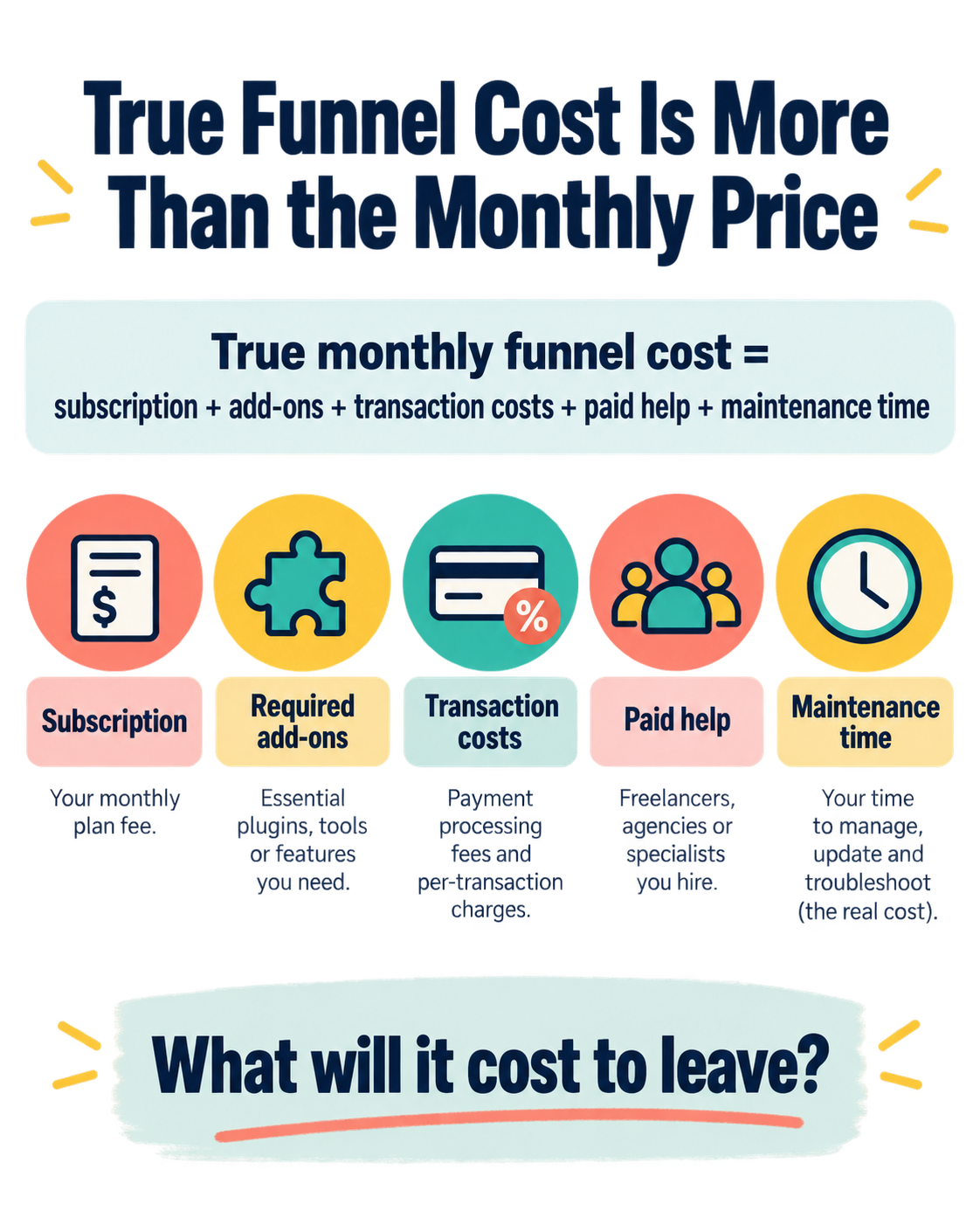
The true cost may also include payment processing, transaction fees, contact limits, email or SMS usage, extra team members, migration, and time.
Then there is lock-in.
My old funnels kept me paying because rebuilding felt worse than another charge. That is a cost even when it never appears on the pricing page.
Use this calculation:
True monthly funnel cost = subscription + required add-ons + transaction costs + paid help + maintenance time
Then add one more question:
What will it cost to leave?
The table below shows only how many $27 sales equal the listed subscription price. It ignores payment fees, transaction charges, taxes, refunds, and the cost of creating the product. It is not profit math.
| Monthly subscription example | $27 sales equal to the subscription alone |
| $10 | 1 sale |
| $17 | 1 sale |
| $47 | 2 sales |
| $59 | 3 sales |
| $97 | 4 sales |
| $179 | 7 sales |
| $297 | 11 sales |
A funnel can still be worth much more than the software bill.
The point is to compare the price with this offer at this stage—not with the business you hope to build someday.
Checkout and Product Delivery Are Separate Decisions
A sales page does not collect money by magic.
The funnel builder needs a payment path. Depending on the platform, that may mean a native checkout, Stripe, PayPal, another processor, or a reseller/Merchant-of-Record platform such as Digistore24.
The right choice depends on what you want handled.
| Payment path | You may handle | The platform may handle |
| Your own processor connection | Seller responsibilities, product setup, policies, taxes, refunds, and related operations | Payment authorization and transfer according to the processor’s service |
| Digistore24 checkout | Product quality, offer, marketing, affiliate materials, and your own business obligations | Checkout, payment processing, transaction operations, and reseller/Merchant-of-Record responsibilities within its terms |
Digistore24 also supports order bumps and one-click upsell flows. Its Conversion Cockpit can compare sales-page or order-form variants based on revenue and other transaction data.
That matters after the first funnel is live.
First, make sure the buyer can pay and receive the promised product. Then use the Pagewheel sales funnel optimization process to improve one measurable part at a time.
What an AI Funnel Builder Should Do
AI should remove the blank page.
It should not make the business decision for you.
Pagewheel can draft a page from the product description, suggest titles and subtitles, help build the digital product, create delivery assets, and generate promotional copy.
You still decide:
- Who the product serves
- What problem it solves
- What proof is honest
- What the price means
- Which next step is useful
That is the split I want.
Let the software handle repeated assembly. Keep the judgment.
The Pagewheel landing page templates guide explains how to use a proven structure without forcing the offer into a static design. The Pagewheel what is a lead magnet guide covers the free front-end path.
Build the Minimum Viable Funnel in Pagewheel
A simple Pagewheel funnel can begin with five decisions.
1. Choose the Offer
Use one product for one specific person.
Upload something you already created, draft a PDF with an AI tool and review it, or build the product page by page inside Pagewheel.
2. Build the Page
Describe the product and let Pagewheel draft the offer page. Replace broad claims with the actual promise, examples, proof, and next step.
3. Choose the Payment Path
For a free resource, set the price to zero. Pagewheel connects the opt-in, thank-you or delivery page, and first delivery email.
For a paid product, connect the appropriate checkout path. Pagewheel currently supports simple payment connections and direct links to Digistore24 product checkouts.
4. Confirm Delivery
Test the complete customer path.
Submit the form or make a test purchase. Open the email. Click the product link. Check the page on a phone.
A funnel is not finished because the sales page looks good.
It is finished when the customer receives what you promised.
5. Publish and Learn
The first version gives you something to improve.
Three sales from a three-month, $5,000 project felt like a disaster to me. Three sales from a funnel built in an afternoon would have felt like a signal.
Keep the first learning cycle cheap enough that you still have energy for the second one.
Choose the Builder That Matches the Job
| Your current job | Start by evaluating |
| Launch one digital product or lead magnet quickly | Pagewheel, with the payment path that fits the offer |
| Build on a permanent free plan and assemble the system yourself | Systeme.io |
| Run direct-response funnels with deeper native testing | ClickFunnels |
| Combine pages, email, membership, support, and marketing operations | Kartra |
| Manage clients, locations, pipelines, calls, and automations | GoHighLevel |
| Host a growing course, community, and expert business | Kajabi |
You may outgrow a tool.
That is normal.
Start with the tool that matches today’s job and gives you a reasonable way to move tomorrow.
Frequently Asked Questions About Sales Funnel Builders
What is a sales funnel builder?
A sales funnel builder is software used to create and connect pages that move someone from interest to an action. That path may include an opt-in or sales page, checkout, thank-you page, product delivery, and follow-up.
What is the best sales funnel builder?
The best choice depends on the job. Pagewheel fits creators launching focused products. Systeme.io is strong for a low-cost do-it-yourself build. ClickFunnels supports direct-response testing. GoHighLevel serves agencies. Kartra and Kajabi provide broader business systems.
Is there a free sales funnel builder?
Systeme.io offers a permanent free plan with limits. Pagewheel lets you build before paying, but publishing and hosting require a paid plan. Several other platforms offer time-limited trials rather than permanent free access.
What should a funnel builder for beginners include?
Start with connected pages, a clear payment path, automatic product delivery, editable content, and understandable costs. Add CRM, SMS, communities, and complex automation when the business requires them.
Does Pagewheel include payment processing?
Pagewheel builds and hosts the page and can connect it to supported payment paths, including a Digistore24 checkout. Digistore24 processes the transaction under its pricing and terms.
Can I move a funnel to another platform later?
That depends on where the pages, product files, email contacts, automations, checkout, and customer access live. Ask about exports and cancellation behavior before building. Pagewheel’s current public offer says users can export a generated sales page’s HTML and CSS for outside hosting, although connected services may still need to be rebuilt.
The Builder Should Make Launching Easier
I spent years paying for more funnel system than some of my products needed.
The software was not bad. The match was bad.
Score the options against the seven things you need now. Pay attention to where your pages and products will live. Build the smallest funnel that can take a real customer from promise to delivery.
Then launch it while you still like the idea.