


I have published four books, and I used a book funnel with every one of them.
For my first book, 101 Kids Activities That Are the Bestest, Funnest Ever!, I created a preorder gift: a six-month play guide covering all 101 activities in the book.
The book gave parents, grandparents, and caregivers the instructions. The play guide gave them a plan for actually using those ideas.
Quick clarification: this article is about a book funnel—two words—which is a marketing path built around a book. BookFunnel—one word—is a separate service specializing in ebook, audiobook, advance-copy, and reader-magnet delivery.
My original funnel was simple. Readers emailed proof of preorder to a special email address. An automated reply delivered the play guide.
It worked, but it was definitely held together with the online-marketing version of duct tape.
For later books, I used a much simpler landing-page and delivery-page flow. Today, Pagewheel can build the opt-in or offer page, thank-you page, product delivery, and delivery email around the resource.
That is the important part of a book funnel. It gives the reader a useful next step instead of ending the relationship at “Thanks for buying my book.”
What Is a Book Funnel?
A book funnel is a connected series of pages and actions built around a book.
The funnel might begin before publication with a waitlist. It might reward a preorder with a useful companion guide. It might sell a digital book directly. It might give away a chapter to introduce a new reader to the author. It might help someone move from reading a nonfiction book to taking a workshop.
The book is the entry point.
The funnel answers one simple question:
What is the most useful thing this reader can do next?
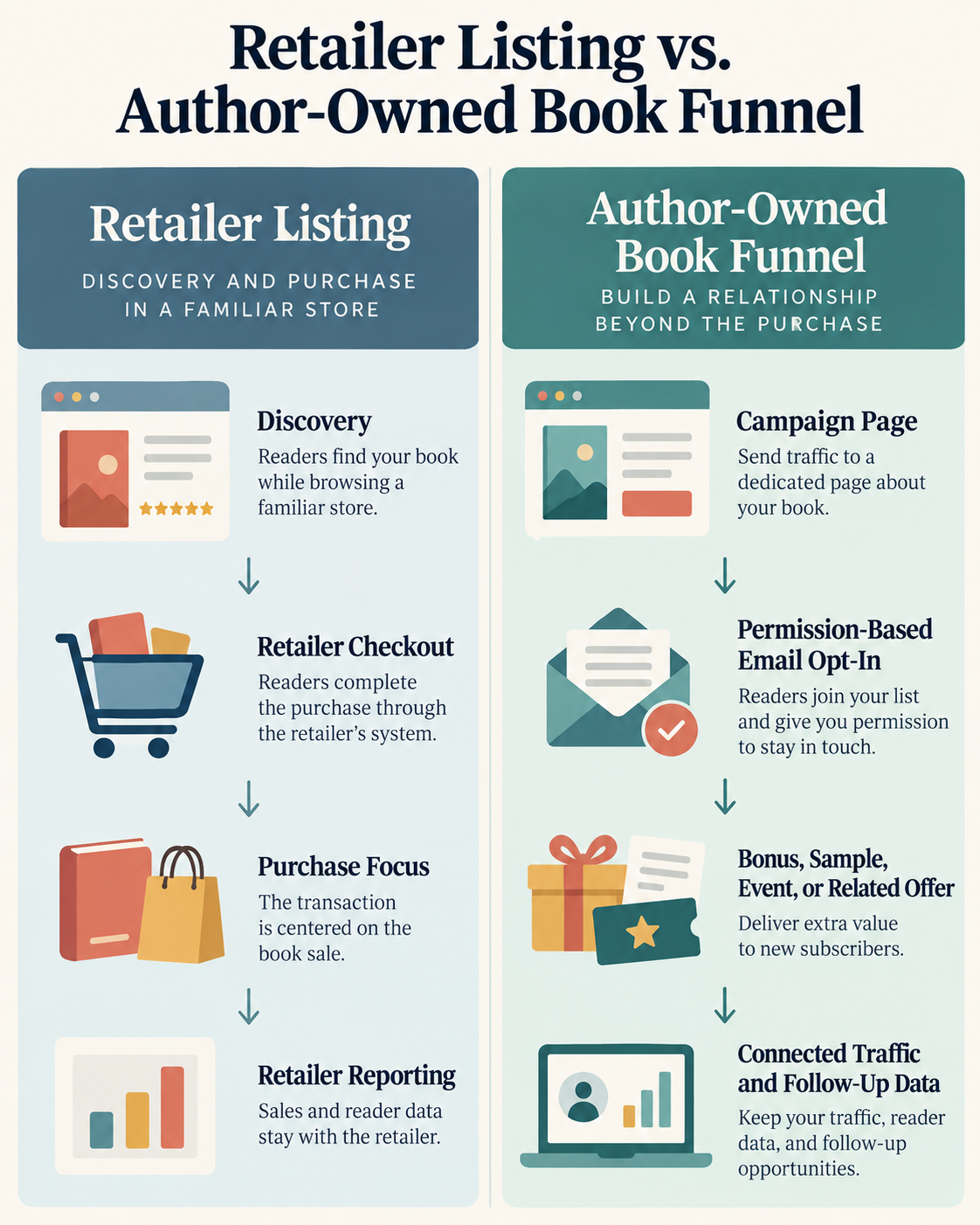
A retailer listing and a book funnel do different jobs.
| Retailer listing | Author-owned book funnel |
| Helps readers discover and purchase the book in a familiar store | Gives the author a page built around a specific campaign or reader action |
| Uses the retailer’s checkout and customer experience | Can collect permission-based email opt-ins through the author’s page |
| Focuses on the book purchase | Can deliver a bonus, sample, event registration, or related offer |
| Provides retailer reporting | Can add traffic, opt-in, delivery, checkout, and follow-up data from the tools the author connects |
You do not have to choose one forever.
My first funnel supported a retailer preorder. The book sale happened elsewhere. My funnel delivered extra value to the reader.
That combination can work beautifully.
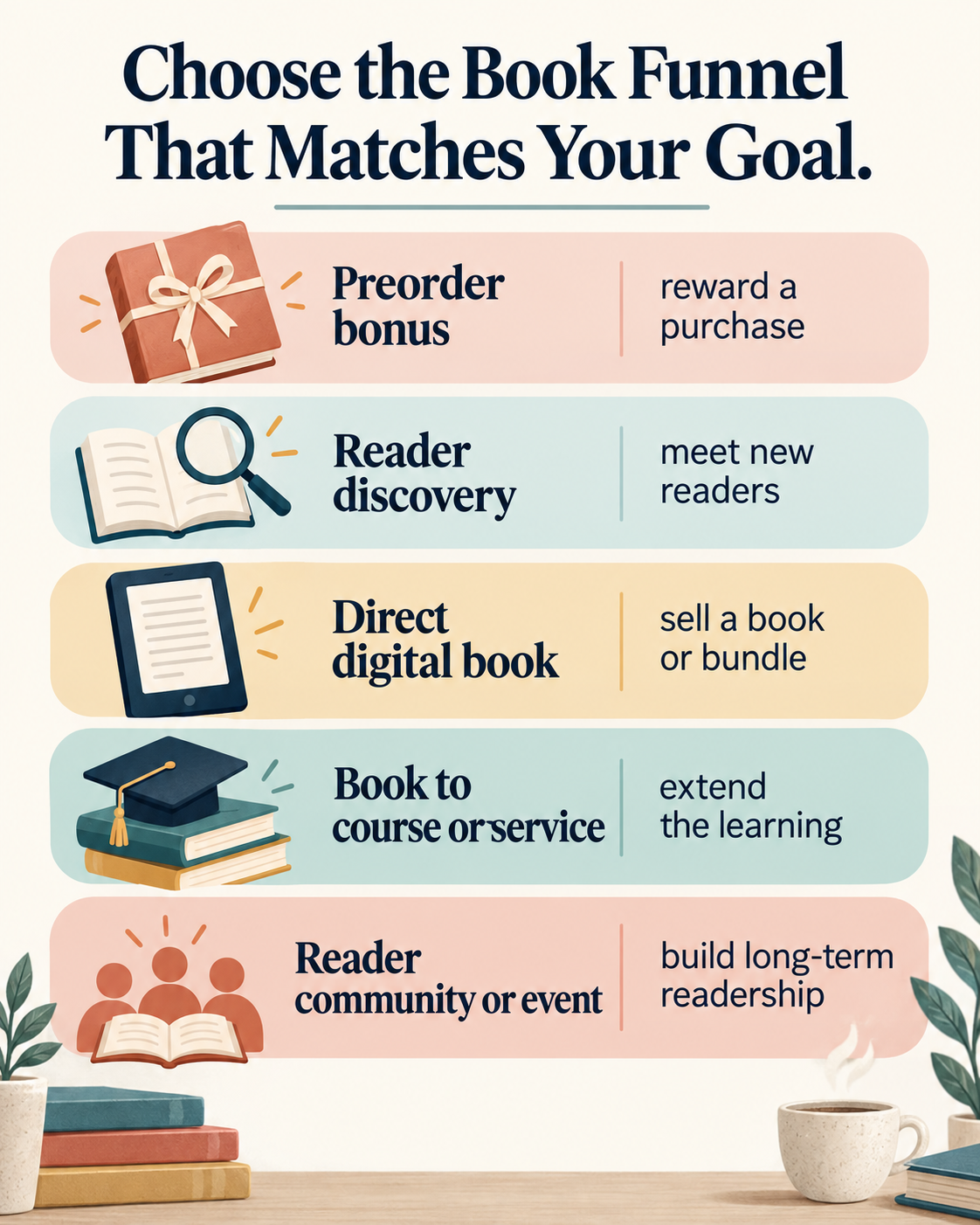
Choose the Book Funnel That Matches Your Goal
The mistake is hearing “book funnel” and assuming every author needs a free-plus-shipping offer followed by a $10,000 mastermind.
No.
Your funnel should match the job your book is doing.
| Book funnel type | Best for | First reader action | Useful next step |
| Preorder or purchase-bonus funnel | Authors launching through a retailer or publisher | Buy or preorder the book | Receive a companion guide, calendar, workbook, or bonus |
| Reader-discovery funnel | Authors who need to meet new readers | Request a sample chapter or related resource | Join the email list and learn more about the book |
| Direct digital-book funnel | Authors selling an ebook, guide, or bundle themselves | Buy the digital book | Add a workbook, audio resource, or workshop |
| Book-to-course or service funnel | Nonfiction authors, speakers, consultants, and coaches | Read the book or request a resource | Take a workshop, course, assessment, or consultation |
| Reader community or event funnel | Fiction, nonfiction, and children’s authors building long-term readership | Register for an event or join a reader group | Attend a signing, Q&A, book club, launch, or future release |
Build one of these first.
You are not required to launch all five before lunch.
1. The Preorder or Purchase-Bonus Funnel
This is the funnel I used for 101 Kids Activities That Are the Bestest, Funnest Ever!
The offer was not “Buy my book because I would really enjoy seeing it on a bestseller list.”
The offer was: preorder the book and receive a six-month play guide that helps you use all 101 activities.
The bonus made the book more useful.
That is the test for a good purchase bonus. It should help the reader get the result she wanted when she bought the book.
For a cookbook, the bonus might be a four-week meal plan or grocery list.
For a business book, it might be a decision worksheet or implementation checklist.
For a novel, it might be a map, bonus scene, character guide, or book-club discussion kit.
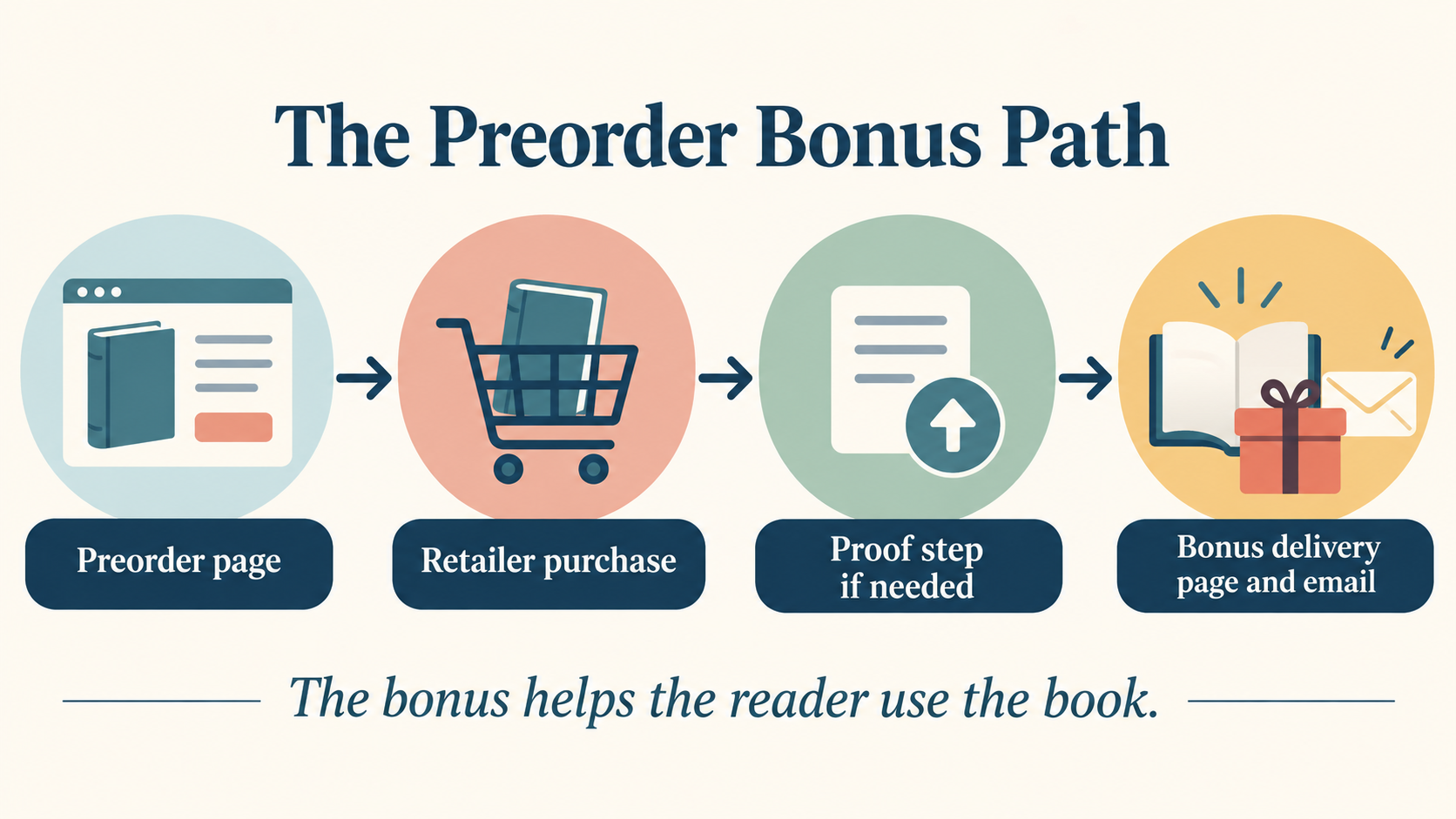
The basic path looks like this:
Preorder page → retailer purchase → proof step if needed → bonus delivery page and email
My original proof step happened through a dedicated email inbox and an automated reply. If you use proof of purchase today, make the instructions simple, collect only what you need, and explain exactly how the bonus will arrive.
Pagewheel can create the bonus itself—or you can upload one you already made—then build the landing page, thank-you page, and delivery email around it.
If the purchase happens at a retailer, the buy button can send the reader there. If verification is required, that remains a separate step you design around the retailer or publisher’s rules.
Pagewheel does not need to pretend it sold the book to make the bonus funnel useful.
2. The Reader-Discovery Funnel
This is the best starting point when the author needs an audience before needing a checkout.
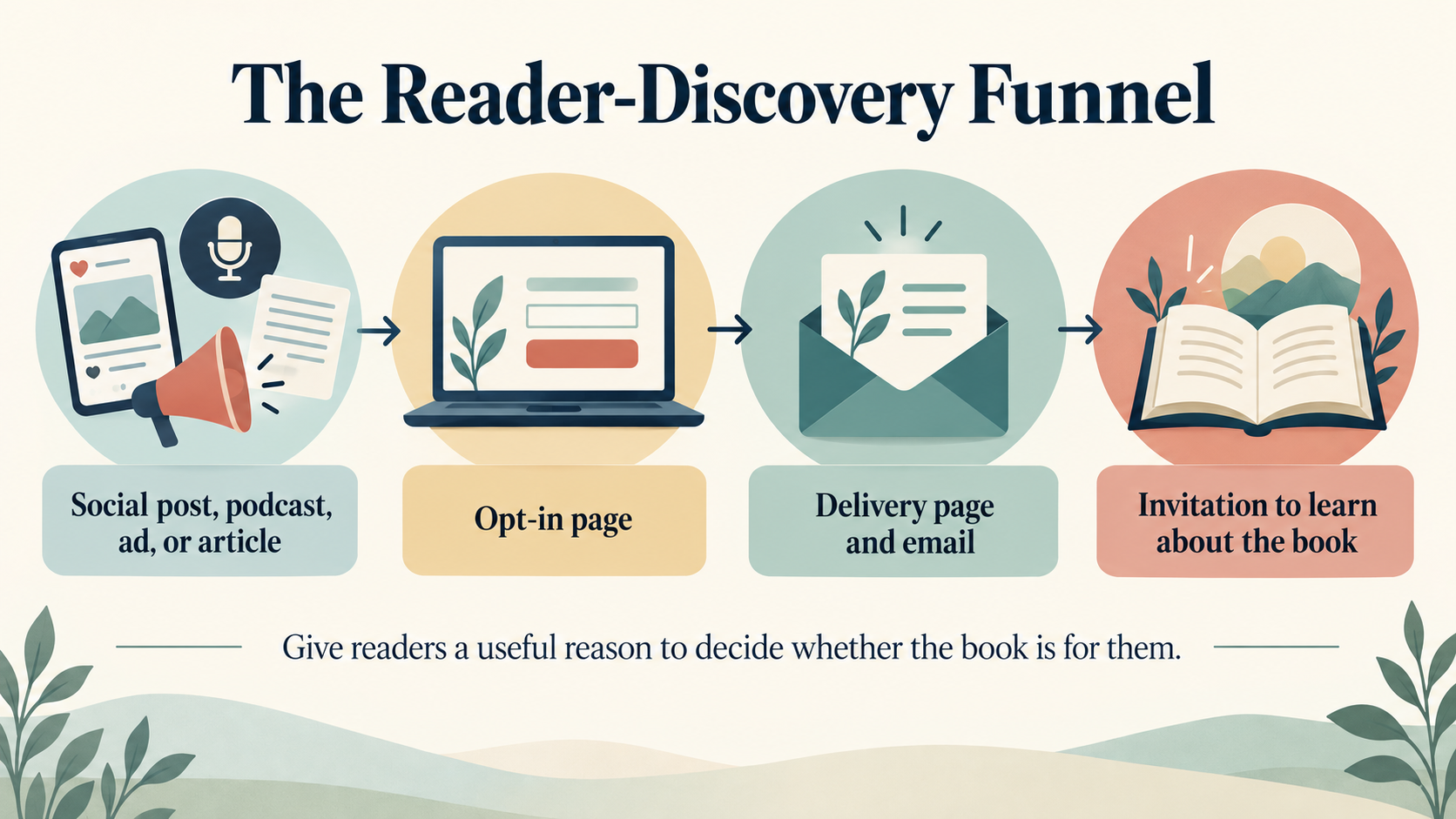
Give the reader something that helps her decide whether the book is for her.
That could be:
- One or two chapters from an adult book
- A short story or prequel for a fiction series
- A discussion guide for a book club
- A printable activity tied to a children’s book
- A checklist, quiz, or worksheet connected to a nonfiction topic
- A behind-the-scenes author note or research guide
The path is short:
Social post, podcast, ad, or article → opt-in page → delivery page and email → invitation to learn about the book
The free resource should attract the same person who is likely to care about the book. This is not about collecting the maximum number of random email addresses.
Inside Pagewheel, you can upload an existing PDF, start with a ready-to-edit product, or build the resource page by page. Pagewheel then drafts the opt-in page, delivery page, and first delivery email.
For more on choosing the right free resource, link this section to the Pagewheel lead magnet article when it is live.
3. The Direct Digital-Book Funnel
A direct book sales funnel is the clearest path for authors who want to sell books direct to readers. It lets the author sell a digital book or related bundle through an author-controlled page.
The path might be:
Sales page → checkout → thank-you and delivery page → delivery email → related next offer
Pagewheel can build the book page and delivery flow. For a paid offer, the creator can connect a supported checkout path such as Stripe or Digistore24.
If the offer uses Digistore24, the checkout can include a relevant order bump.
The word relevant is doing a lot of work there.
A companion workbook can make sense next to a practical book. A printable plan can make sense next to a parenting guide. An audio companion can make sense for a reader who wants another way to use the material.
A completely unrelated product does not become helpful because it sits next to a checkbox.
A free plus shipping book funnel is a physical-book variation. The book price is set at zero, and the reader pays the stated shipping or handling charge. The author still has printing, fulfillment, return, platform, and promotion costs, so “free” does not mean the funnel costs nothing to run.
For any printed book, there is an extra layer. Digistore24 supports selected shipped products, including printed books, but the seller remains responsible for arranging fulfillment or connecting a fulfillment provider.
Pagewheel builds the page. The checkout takes the order. Somebody still has to put the physical book in a box.
If you would rather not manage that, use the Pagewheel page to send readers to the retailer that already handles the transaction and shipping.
4. The Book-to-Course or Service Funnel
This funnel works best when the book teaches the first part of a process and the reader may want help implementing it.
The book should be valuable on its own.
The next offer is not a missing chapter held hostage behind a payment screen. It is a different level of help.
For example:
| Book helps the reader… | A related next offer might help her… |
| Understand a framework | Apply it in a workshop |
| Identify the problem | Build a personal action plan |
| Learn the basic method | Practice it through a course |
| Explore a professional service | Decide whether a consultation fits |
| Start a creative project | Complete it with templates and feedback |
A Pagewheel funnel can introduce the book, deliver a companion digital product, and create the page for the next offer.
That does not mean every author needs a course.
A novelist may have no logical reason to sell coaching. A children’s author may be better served by an activity pack, school visit, library event, or future-book waitlist.
The next offer should follow the reader’s next need, not the author’s desire to add another price tag.
5. The Reader Community or Event Funnel
Some book funnels are not primarily about an immediate sale.
They help an interested reader stay close enough to hear about the next book.
This can be a:
- Launch waitlist
- Virtual Q&A registration
- Book signing page
- Book-club kit
- VIP reader list
- School or library event page
- Early-reader or advance-copy group
The path might be:
Book or author page → event or community invitation → registration → confirmation page and email → later book news
Pagewheel’s author-funnel examples include book waitlists, preorder pages, author feature pages, event pages, bonus pages, and VIP reader-community pages.
This is especially useful before release. A book launch funnel can combine a waitlist, preorder page, and reader bonus so you are not waiting until launch week to discover whether anyone knows the book exists.
What a Book Funnel Can—and Cannot—Do
A funnel organizes the reader’s next step. It can explain the book, collect permission-based opt-ins, deliver a digital bonus, and present a relevant next offer.
It cannot manufacture interest, give you a retailer’s customer list, ship a physical book without fulfillment, or guarantee that buyers or affiliates will appear. The goal is a connected system with honest expectations.
Book Funnel Economics Without the Fairy Tale
A book funnel can increase the value of a customer relationship because some readers may choose a relevant companion product or next offer.
That does not mean a $12 book automatically becomes a $200 customer.
Here is a transparent illustration—not a forecast:
| Funnel step | Price | Hypothetical take rate among 100 initial buyers | Illustrative gross revenue |
| Digital book | $12 | 100 buyers | $1,200 |
| Companion workbook | $17 | 20 buyers | $340 |
| Live workshop | $67 | 5 buyers | $335 |
| Illustrative total | $1,875 |
In this example, the average gross revenue per initial buyer is $18.75.
The workbook adds an average of $3.40 per initial buyer. The workshop adds $3.35.
Those take rates are assumptions chosen only to show the formula. They are not benchmarks. The calculation comes before platform fees, refunds, taxes, fulfillment, affiliate shares, advertising, and support costs.
A self-liquidating book funnel aims to use the initial book and companion sales to offset some acquisition costs. That is a business goal—not a guarantee that every campaign will pay for itself.
Results vary by book, audience, offer, pricing, traffic, and promotion. Some authors will sell no next offers. Others will build a meaningful business around a book. Nothing in this example guarantees either outcome.
The useful question is not “How do I force this customer to be worth $200?”
It is “What would genuinely help this reader take the next step?”
How to Build a Book Funnel in Pagewheel
The workflow changes slightly depending on whether the book is free, sold directly, or purchased through a retailer.
| Step | What to do in Pagewheel | Decision to make |
| 1. Choose the goal | Start a new offer | Waitlist, sample, preorder, bonus, direct sale, event, or next program |
| 2. Add the product | Upload a PDF, use a ready-to-edit product, or build the resource page by page | Is the product the book, a sample, or a companion resource? |
| 3. Build the page | Generate an offer or opt-in page, then edit the copy | What one action should the reader take? |
| 4. Choose checkout | Set the offer to free, connect a paid checkout, or link to the retailer | Where does the transaction happen? |
| 5. Connect delivery | Approve the delivery page and first delivery email | What should the reader receive immediately? |
| 6. Add the next step | Link to a related book, workbook, event, workshop, course, or community | What genuinely helps next? |
| 7. Test | Click every button, submit the form, open the email, download the file, and test checkout | Does the complete reader path work on desktop and mobile? |
The Pagewheel digital product ideas article can help if the companion resource is unclear. Use the landing page templates article to choose a page by reader goal rather than favorite color.
For a retailer purchase, send the buy button to the retailer and explain any bonus-verification step separately. Pagewheel does not automatically inspect a retailer receipt unless you create a process that does it.
For a physical book sold through Digistore24, set up the printed book as an approved shipped product and connect fulfillment. Digistore24 does not ship the book for you.
Then use the Pagewheel sales funnel optimization article to improve one bottleneck at a time after real readers begin using the funnel.
[IMAGE: Pagewheel book offer page showing the book preview, primary CTA, and companion resource]
How Digistore24 Affiliate Distribution Fits
If the book or related digital offer uses Digistore24, the author can create a marketplace entry for affiliates.
The offer does not automatically appear in the marketplace. Digistore24 reviews marketplace entries before approving and publishing them.
Once approved, affiliates can find the listing and decide whether it fits their audiences. A strong entry explains what the product is, why it is worth promoting, where the sales page is, and what support the affiliate receives.
Affiliates use tracked links. If a sale is attributed to an affiliate, the author pays the agreed affiliate share through the platform.
That means the upfront ad bill is not the same as buying cold traffic. It does not mean promotion is free in the larger sense or guaranteed. The affiliate share is a real acquisition cost, and affiliates choose the offers they want to promote.
Any affiliate promoting the book should disclose the relationship clearly and conspicuously under current FTC endorsement guidance.
For a physical book, remember that an affiliate sale creates a shipping obligation. Make sure the fulfillment process works before asking more people to send buyers.
Book Funnel Troubleshooting
| What is happening | Likely issue to inspect first | Practical next move |
| Nobody visits the page | Distribution or message problem | Share with the existing audience, partners, podcasts, events, or approved affiliates |
| People visit but do not act | The promise, reader, or next action is unclear | Match the headline to the traffic source and simplify the main CTA |
| Readers buy the book but ignore the next offer | The next step is unrelated or too large | Offer the closest useful companion result |
| Readers request the bonus but cannot access it | Delivery-page, email, or link problem | Complete the entire flow yourself and repair the broken step |
| A printed book sells but shipping is slow | Fulfillment problem | Check the fulfillment provider, inventory, notification, and delivery process |
| Affiliates see the offer but do not promote it | Weak economics, unclear fit, or missing support | Improve the marketplace entry and give affiliates useful promotional material |
My first preorder funnel used a dedicated email inbox and an automated reply because that was the easiest system I could assemble at the time.
It did not need to be fancy. It needed to work.
The advantage now is that the page, product, delivery page, and delivery email can live in one Pagewheel workflow instead of being stitched together from several tools.
Your First Week After Launch
Do not spend the first week refreshing the sales screen every four minutes.
Use the week to make sure the funnel works and listen to real readers.
| Timing | Focus | What to do |
| Days 1–2 | Test | Walk through every page, button, form, checkout, email, download, and physical-fulfillment handoff |
| Days 3–4 | Soft launch | Share with a small part of the existing audience and watch for questions or confusion |
| Days 5–7 | Review | Check traffic, opt-ins, purchases, delivery, support questions, and next-offer activity |
| Week 2 and beyond | Improve | Change one meaningful bottleneck, then measure again |
A small number of readers can reveal confusing instructions. It cannot prove a universal conversion rate.
Treat the first week as a systems check and a conversation.
Frequently Asked Questions About Book Funnels
Is BookFunnel the same thing as a book funnel?
No. BookFunnel is a specific service for delivering ebooks, audiobooks, advance copies, reader magnets, and other author files. A book funnel is the broader marketing path that connects reader interest to a book and an appropriate next action.
The two can work together, but they are not the same thing.
Can I use a book funnel if my book is sold on Amazon?
Yes. The retailer can handle the book sale while your funnel handles a waitlist, sample, preorder bonus, event, or permission-based email opt-in.
Do not assume the retailer gives you the buyer’s contact information. The reader needs to choose to share it through your author-owned page.
Can I sell a printed book directly through the funnel?
Yes, but a physical book needs fulfillment. Digistore24 supports approved printed-book products, but the seller must arrange shipping or connect a fulfillment provider.
If you do not want that responsibility, link to a retailer that already handles the order and shipment.
What should I offer after the book?
Offer the closest useful next result. That might be a workbook, event, workshop, course, reading guide, another book, or community invitation.
It might also be nothing. A book can simply lead to a better relationship with the reader.
Do I need my own website?
You need a clear page and a connected delivery or checkout path. Pagewheel hosts the pages it creates and can connect the product, offer page, delivery page, and delivery email.
Does a book funnel guarantee more sales?
No. It gives the reader a clearer path and gives the author more ways to measure, deliver, and follow up. Traffic, trust, the book, the offer, and the execution still matter.
Start With One Reader and One Next Step
My first book funnel did one thing.
A reader preordered the book. I gave her a six-month play guide that helped her use all 101 activities.
That was enough.
Open Pagewheel and choose one book-funnel goal. Upload the book, sample chapter, workbook, play guide, or reader gift. Let Pagewheel draft the page and delivery flow. Edit it until it sounds like you.
Then test it with one real reader.
You do not need five funnels today.
You need one useful next step that works.